

As we settle into the school year, it is worth taking the time to consider the particular stress and expectations that students experience. We can put in place early interventions while exams are still in the distance.
 Tips for combating achievement culture (4:24)1
bit.ly/TipsAchievementCulture
The South African context
A recent study of the pressures experienced by young South Africans found that they ‘face unique stressors related to the country’s socioeconomic landscape, including high unemployment rates, financial instability and cultural expectations’.3 Interestingly, the authors found ‘critical themes, such as the pressure of academic and career success, family responsibilities and the impact of socio-economic disparities’.3
This suggests that there is even more pressure to succeed, given our socio-economic context. For the matric class of 2025, there were 340 000 bachelor’s passes recorded nationwide, but only about 235 000 spaces for 2026 in South African public universities.4 As principal Mark Potterton noted, ‘high achievement did not guarantee opportunity. The pressure on young people is immense: for many, the path to university defines or derails their sense of worth’.5
The challenge then, for parents, guardians and teachers, is to have a realistic understanding of this situation, while at the same time, supporting students, so that they are not overwhelmed by stress, panic and pressure.

Toxic achievement culture
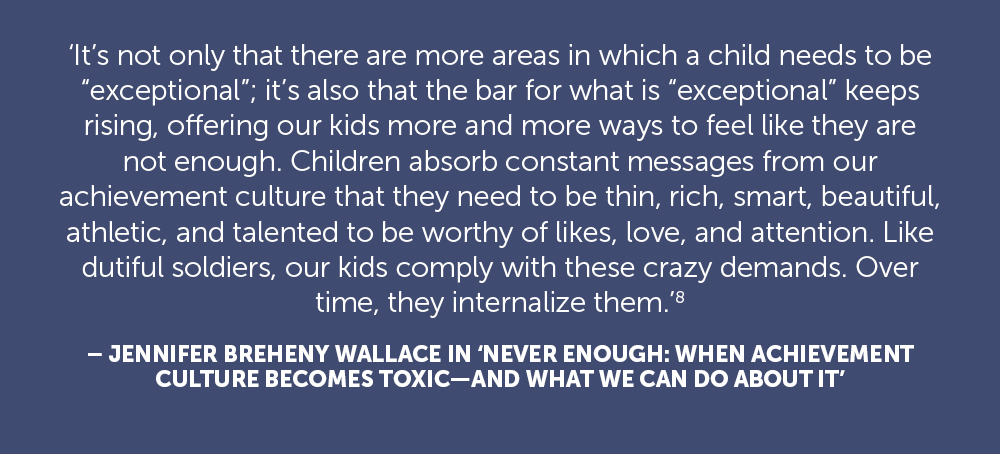
In her bestselling book ‘Never Enough: When Achievement Culture Becomes Toxic—and What We Can Do About It’, Jennifer Breheny Wallace uncovers the rise of toxic achievement culture and proposes strategies for fighting it. She recalls her initial shock at reading about elite schools in the US where the students were officially deemed ‘at risk’, a label conventionally used to refer to young people living in poverty or violent contexts. These elite students were at risk for ‘higher rates of clinical levels of anxiety, depression, substance abuse disorder than the average American teen’.6 They were in what Wallace terms ‘a gilded pressure cooker’.6 The pressure to excel was as unhealthy for teenagers as factors such as poverty, trauma and discrimination.
This pressure is exacerbated by the expectations of parents, communities and schools. Social media, peer competition and a society obsessed with results and displays of wealth are among other factors that affect it.

In a survey carried out for her subsequent research, 70% of respondents agreed that ‘their parents “valued and appreciated” them more if they were successful in school’.7 50% said ‘their parents loved them more when they were successful’.7 While striving to succeed is not inherently bad, this sense young people have that their self-worth is dependent on their achievements is ‘toxic achievement culture’. They desire to be valued regardless of these external accomplishments. Nurturing their sense of being valued, of ‘mattering’, is another way to respond to this toxic culture.
 Activity: Debate and LO essay practice
You can practise the key elements of an LO essay by debating an issue related to toxic achievement culture. Consider the prompt:
To what extent do you agree or disagree with the following statement:
Teenagers’ self worth is largely based on their academic and extracurricular achievements.
- Divide the class into two groups: one group agrees with the statement and the other disagrees.
- Each group should come up with three strong arguments in favour of their stance.
- Choose three representatives from each group to present one of their arguments to the class.
- Discuss which stance was most convincing.
Everyone can share their thoughts on toxic achievement culture and its impact.
Good enough for now
Being reminded of failure and the messy process on the way to success are other ways of countering toxic achievement culture.
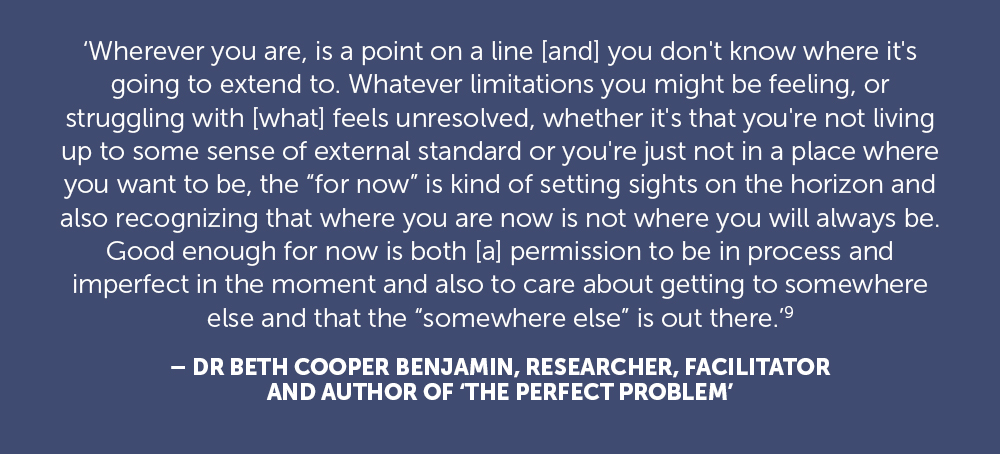
In an interview for the ‘Good Enough for Now’ podcast, Dr Beth Cooper Benjamin reflects on the value of making process – and mistakes, or failure – visible in the classroom and in life. This ‘gives permission to other people, to also be human, to be intrinsically imperfect beings’.9 It could be as simple as reminding students not to erase their working out for a maths or science problem, or showing their first drafts, edits and revision in a piece of writing. She explains that ‘if we want to do meaningful, important, good work in the world, we have to care about excellence. Sure, but the way to get to excellence, involves inevitably, a messy process… every field has its version of leveraging a kind of mess and imperfection and flaw or failure to get to better work.’9
Lessons of failure
In an interview with celebrated author and Nobel Laureate Wole Soyinka and world-renowned artist William Kentridge, composer Neo Muyanga began with a question about failure. He admitted that he first wanted to be a physicist and asked Soyinka and Kentridge what they had ‘failed successfully at’.10 Soyinka had at first imagined he would be a lawyer, then a pilot, a sailor in the navy or an architect; he still wishes to be an astronaut. Kentridge wanted to be an elephant (at age three!), an orchestra conductor and an actor. While these failures were experienced as painful at the time, all three agreed on the lessons learnt by the failures.10
Activity: Learning from failure
Ask students to research the life story of someone they admire. It could be a family member, a community member or someone famous, and find examples of failure in their life.
- Briefly describe this person’s achievements and explain why you admire them.
- What did this person fail at? How did they respond?
- Reflect on the process. What did you learn?
Growth mindset
Parents and teachers often contribute to the cycle of not feeling good enough – sometimes unwittingly, or with good intentions. They wish to prepare young people for the world around them. Former principal, Mandy Herold, diagnoses another element in the South African context: ‘Parents see their children’s performance or lack thereof as a direct reflection on them and their identity, how they are showing up’. 11 Herold reminds parents not to judge themselves by their children’s current achievements. She promotes ‘a growth mindset approach, where value is placed on the learning journey rather than just the outcomes. It prioritises the pursuit of personal growth and excellence by setting realistic standards and being motivated by self-improvement rather than a fear of failure.’ 11
Developing a Growth Mindset with Carol Dweck (9:37)13
bit.ly/GrowthMindsetTalk
Dweck is interested in the power of ‘yet’.13 She explores the uplifting and empowering impact of receiving the grade ‘not yet’, rather than failing.
Growth Mindset For Kids (5:43)14
bit.ly/GrowthFixedMindsetExplanation
Tips to develop a growth mindset:14
- Embrace challenges
- Learn from mistakes
- Believe in yourself
- Seize the power of ‘yet’.
- Celebrate effort.
- Welcome feedback.
Growth Mindset Teaching Helps Students Make the Grade (3:11)15
bit.ly/GrowthMindsetTeaching
Associate Professor Chris Bryan proposes some ideas that teachers can use to underline their belief in the students’ potential. For example:
‘I don’t care so much what you know now, what I care about is how much you’ve learned by the end of the year. And if you put in the work to learn, I’ll be there to make sure the work pays off.
It is not about how good you are now, it’s about how much you can improve.’115
Adopting a growth mindset is not a magic fix, but a first step. There will still be challenges, frustrations and disappointments, but you will be better equipped to respond to them and to bounce back from them.
Activity: From Fixed Mindset to Growth Mindset16
- Rewrite the following sentences so that they transform from fixed mindset statements into growth mindset ones. For example: ‘I’m not good at this’ could become ‘I can’t do this yet’.
• I give up.
• I will never be as clever as them.
• I can’t make this any better. - Think of something you can do well. You can write it down, or draw it.
- How did you become good at it?
- Complete the following sentences:
• I can’t _________ yet.
• I don’t know __________ yet.
5. How could you use your answer to question 3, to realise the goals in question 4?
Extension activity: Growth mindset
- List realistic goals that you are ‘not yet’ capable of achieving.
- Choose one goal and list the character traits you will need in order to achieve it (for example, grit, persistence)
- Consider the steps you can take now in order to reach your goal.
- What support will you need in order to reach your goal? Who can you ask for help?
- If you are unable to fulfil your goal, how would you respond? Is there a second option you could realise instead?
The aim of this activity is not to induce panic, but rather encourage gentle planning that develops confidence, while allowing the possibility of failure and back-up plans.
A sense of mattering
Jennifer Wallace argues that we shouldn’t give up on excelling, but rather strive in a healthy manner. Her research shows that those who do this have a sense of ‘mattering’.1 They feel valued for who they are, and are relied on to give value back to others. Furthermore, a child’s resilience depends on their caregiver’s resilience. She suggests parents should: minimise criticism, prioritise affection, ‘get a PhD’ in their children (that is, know them for who they are), ask questions about their day that aren’t centred on their achievements and finally, ‘never worry alone’.1

‘Seven critical ingredients to feeling like you matter:
- Attention: Feeling that you are noticed by others
- Importance: Feeling like you’re significant
- Dependence: Feeling like you’re important because others rely on you
- Ego extension: Recognizing that someone is emotionally invested in you and cares what happens to you
- Noted absence: Feeling like you’re missed
- Appreciation: Feeling like you and your actions are valued
- Individuation: Being made to feel unique, special, and known for your true self’ 8
– Jennifer Breheny Wallace in ‘Never Enough: When Achievement Culture Becomes Toxic—and What We Can Do About It’
Wallace’s latest book ‘Mattering: The Secret to a Life of Deep Connection and Purpose’ delves deeper into the concept of mattering.
Why We Need to Know Our Lives Matter | Jennifer Wallace | TED (12:33)17
bit.ly/NeedLivesMatter
Activity: Reflection on mattering
As a way of pivoting from toxic achievement culture to healthier ways of being, students can reflect on what matters to them, and how they matter to others.
In your journal or notebook, answer the following questions:
- What is important to me?
- What do I like most about myself?
- What motivates me to do well?
- What am I grateful for?
- How can my friends, family and teachers show me that I matter?
- How can I show my friends, family and teachers that they matter?
Closing thoughts
In the classroom, we can do our best to show all students that they matter and have value, regardless of their results. This does not mean accepting laziness or poor excuses, but rather encouraging students and reminding them of the power of ‘yet’. Focusing on developing the characteristics of grit, resilience and a growth mindset will empower students to explore their interests and be willing to learn from failure, rather than being afraid of it.
IMPORTANT DAYS THIS MONTH:
8: International Women’s Day
21: Human Rights Day
21: World Poetry Day
22: World Water Day
If you are using the Achieve Careers LO Programme, the following information and activities are recommended to coincide with the theme of ‘toxic achievement culture’ and the important days above:
- Grade 7 LO Manual – Module 1 (Self-Esteem and Self-Awareness), Module 2 (Health & Well-Being) and Module 3 (Peer Pressure)
- Grade 8 LO Manual – Module 1 (Identity, Belonging and Self-Esteem), Module 3 (Addiction) and Module 4 (Relationships)
- Grade 9 LO Manual – Module 1 (Goal Setting & Organisational Skills) and Module 3 (EQ: Mental Health & Mindfulness)
- Grade 10 LO Manual – Module 2 (Community Service) and Module 4 (Gender Equality)
- Grade 11 LO Manual – Module 1 (Interpersonal Skills & EQ)
- Grade 12 LO Manual – Module 2 (Success Strategies)
- Grades 7, 8 and 9 LO Manuals – Module 3 (Constitutional Rights and Responsibilities)
- Grade 10 LO Manual – Module 2 (Democracy and Human Rights)
- Grades 11 and 12 LO Manuals – Module 3 (Democracy and Human Rights)
- Teacher’s Flash Drive – LO Resources – folders on Addiction, Bullying, Democracy and Human Rights, Emotional Intelligence, Gender Equality, Goal Setting and Decision-Making, Grit and Growth Mindset, Motivation, Racial Equity and Self-Esteem, Stress
References:
- Good Morning America, 2023. Tips for Combating Achievement Culture, Available: bit.ly/TipsAchievementCulture [23 Feb 2026].
Website: www.goodmorningamerica.com - Porter, K.S. (2026) ‘From Hustle to Human: Rethinking Success Beyond Toxic Achievement Culture’, Leadership Circle, [Electronic], 10 Jan, Available: bit.ly/HustletoHuman [24 Feb 2026].
- Lappeman, J., Broster, P., Madurai, M., Masipa, M.S. and Cheteni, P. (2025) ‘“Can We be Young and Carefree?” Using the Roy Adaptation Model to Explore Youth Pressure in South Africa’, Young Consumers: Insights and Ideas for Responsible Marketers, [Electronic], vol. 26, no. 7, 15 Dec, pp. 254–273, Available: bit.ly/YouthPressureSA [24 Feb 2026].
- Goni, S. (2026) ‘Bachelor’s Pass isn’t a Ticket to University, says Manamela, but TVETs and CETs are an Option’, Daily Maverick, [Electronic], 22 Jan, Available: bit.ly/BachelorsPass [24 Feb 2026].
- Potterton, M. (2026) ‘Incessant Push to Perform Takes a Toll on Children’s Mental Health’, Daily Maverick, [Electronic], 20 Feb, Available: bit.ly/PushToPerform [23 Feb 2026].
- Burnett, T. (2025) ‘Breaking the Cycle of Toxic Achievement Culture’, John Templeton Foundation, [Electronic], 4 Sept, Available: bit.ly/ToxicAchievementCycle [23 Feb 2026].
- Abdullah, M. (2023) ‘Why Achievement Culture Has Become So Toxic’, Greater Good Magazine, [Electronic], 30 Aug, Available: bit.ly/AchievementToxicWhy [23 Feb 2026].
- Good Reads. Never Enough Quotes, [Online], Available: bit.ly/AchievementCultureQuotes [23 Feb 2026].
- Good Enough for Now. (2023) Letting Go of Achievement Culture with Dr. Beth Cooper Benjamin, [Online], Available: bit.ly/BethBenjamin [23 Feb 2026].
- The Centre for the Less Good Idea, 2024. Wole Soyinka, William Kentridge & Neo Muyanga | In Conversation
Available: bit.ly/SoyinkaKentridgeMuyanga [23 Feb 2026]. Website: www.lessgoodidea.com
- Hip, C.H. (2025) ‘Former Principal Warns against Toxic Achievement Culture’, EWN, [Electronic], 19 Nov, Available: bit.ly/KidsBeKidsSA [23 Feb 2026].
- Kaitano, T. (2023) ‘30 African Proverbs about Success and Hardwork’, Vocal Media, [Electronic], Available: bit.ly/AfricanProverbsSuccess [24 Feb 2026].
- Stanford Alumni, 2014. Developing a Growth Mindset with Carol Dweck
, Available: bit.ly/GrowthMindsetTalk [23 Feb 2026]. Website: www.alumni.stanford.edu
- Mental Health Center Kids, 2024. Growth Mindset For Kids – Growth Mindset vs. Fixed Mindset – The Power Of Yet – Elementary – Middle School
, Available: bit.ly/GrowthFixedMindsetExplanation [23 Feb 2026]. Website: www.mentalhealthcenterkids.com
- McCombs School of Business, 2024. Growth Mindset Teaching Helps Students Make the Grade
, Available: bit.ly/GrowthMindsetTeaching [23 Feb 2026]. Website: www.mccombs.utexas.edu
- Great Minds Together. Growth Mindset Workbook, [Online], Available: bit.ly/GrowthMindWorkbook [23 Feb 2026].
- TED, 2025. Why We Need to Know Our Lives Matter | Jennifer Wallace | TED
, Available: bit.ly/NeedLivesMatter [24 Feb 2026]. Website: www.ted.com


