

The origins and meaning of Workers’ Day
On the first of May, countries around the world marked International Workers’ Day. In South Africa, the day has particular resonance as it honours the contributions of trade unions, the Communist Party and labour movements in the struggle against apartheid.1
As we honour the historical achievements of workers in advocating for fair working conditions and opposing exploitation, it is vital to pay attention to workers’ rights and dignity – today and in the future.
 Activity
- Research the origins of Workers’ Day. What are some of the key achievements made by workers across the globe to improve their quality of life?
- The Constitution of South Africa enshrines certain rights for all employees. In small groups, discuss the significance of these rights. What additional right would you add to the list? Motivate for its inclusion.
- There are also key laws and acts that protect employees’ rights in the workplace. Can you list these?
- In addition to their rights, employees also have responsibilities. Create a list of ethical responsibilities that you believe all employees in South Africa should adhere to.
The world of work today
In their 2026 Gen Z and Millennial Survey, Deloitte Global observed how these generations have changed the world of work: ‘driving an evolution in leadership and workplace culture; normalising flexible and hybrid work; advancing more open conversations about mental health; and elevating purpose and values as visible factors in career decisions’.2
In terms of an ideal workplace, purpose and connection are imperative. More than 95% of the 22 500 people surveyed around the world stated that ‘having a sense of purpose at work is important to their overall job satisfaction and well-being’.2
Furthermore, friendship is a deciding factor in workplace loyalty: those with ‘close workplace friendships are more likely to plan to stay with their organisation longer’.2
As the rate of change in the world can make your head spin, ‘adaptability has become a core career capability’.2
Dream jobs
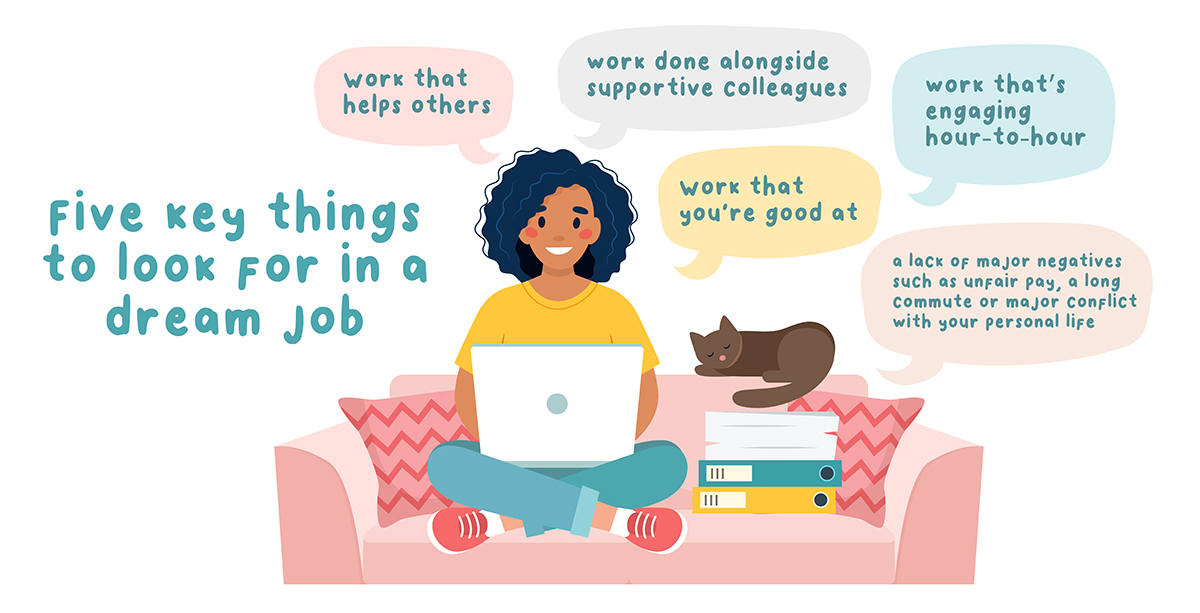
The organisation ‘80,000 Hours’ – so named because people typically have 80,000 working hours in their careers – reviewed three decades of career research. They determined that the five key things to look for in a dream job are:3
- work that’s engaging hour-to-hour
- work that helps others
- work you’re good at
- work done alongside supportive colleagues
- a lack of major negatives such as unfair pay, a long commute or major conflict with your personal life
Activity
- While it is unlikely that the perfect workplace exists, it is inspiring to imagine one as you start to research your career path. In small groups, describe your ideal workplace. Pay attention to the organisational culture, ethics, work-life balance, financial compensation, leadership style, approach to skills development and how a sense of purpose is conveyed.
- Research whether you can find any organisations that meet this vision. If not, consider how you can revise your expectations to meet reality. Which aspects of your ideal workplace are non-negotiable and why?
- List your top five values. How do they compare with the values of the rest of the group? What will you do if your values do not align with those of your workplace?
- What can you do, while still at school, to improve your adaptability?
- On your own, write a reflection in response to this activity. Summarise what you have learnt that will be constructive in planning for your career.
AI and work
AI has become an inescapable factor in the world of work. The impact of AI differs depending on the type of career or industry. There are concerns about what it will mean for entry-level roles: ‘The head of the International Monetary Fund, Kristalina Georgieva, has warned young people will suffer the most as an AI “tsunami” wipes out many entry-level roles in coming years.’4 The World Economic Forum reported in March this year that ‘postings for entry-level jobs in the US have plummeted by 35% in the last 18 months, in large part because of AI’.5 While these figures are stark, many young people have been spurred to innovate. One way this manifests is with young people creating their own jobs. The Guardian suggests that Generation Z is ‘turning into Generation Entrepreneur’ and many are using AI to achieve this.6
Activity
It is important to be aware of and research the potential impact of AI on your chosen career field, in order to adequately prepare for your future.4
- Research two careers that interest you.
- Can you find evidence of how AI is changing – or might change – the industry?
- Do you know anyone currently working in this career? If so, ask them about the impact of AI on the industry.
- Ask your parents, guardians or adults you know about the impact of AI on their careers.
- As a class, discuss your research results and what you can do to equip yourself for the world of work.

Durable skills
If you are using the Achieve Careers programme, our manuals across the grades explore career research and preparing for life after school, with a focus on subject choice in Grade 9 and job shadowing in Grade 11. It is never too soon for students to start cultivating durable skills for the AI Age.4 School can be a context to nurture their communication, adaptability, creativity, leadership and critical thinking skills4 so that they can approach the world of work and search for their dream jobs with open-mindedness, curiosity, agility and confidence.
IMPORTANT DAYS THIS MONTH:
28: Menstrual Hygiene Day
29 May – 5 June: Child Protection Week
If you are using the Achieve Careers LO Programme, the following information and activities are recommended to coincide with the theme of ‘Workers’ Day’:
- Grade 7 LO Manual – Module 5 (Careers)
- Grade 8 LO Manual – Module 5 (Learning Strategies and Careers)
- Grade 9 LO Manual – Module 5 (Subject Choice, Including Self-Awareness)
- Grade 10 LO Manual – Module 5 (Career Research)
- Grade 11 LO Manual – Module 3 (CV Writing and Job Shadowing) and Module 4 (Career Research)
- Grade 10 CAPS Ebook – Module 3 (Careers and Career Choices)
- Grades 12 CAPS Ebook – Module 4 (Careers and Career Choices)
- Teacher’s Flash Drive – LO Resources – folders on Careers, CV Writing, Interview Skills, Personal Finance, Personal Mission Statements and University
References:
- South African History Online. (2019) May Day, [Online], Available: bit.ly/MayDaySouthAfrica [21 May 2026].
- Deloitte Global. (2026) 2026 Gen Z and Millennial Survey: Progress on Their Own Terms, [Online], Available: bit.ly/GenZMillenialSurvey [21 May 2026].
- Todd, B. (2026). ‘We Reviewed over 60 Studies about what Makes for a Dream Job. Here’s what we Found’, 80,000 Hours, [Electronic], 12 May, Available: bit.ly/DreamJobGuide [21 May 2026].
- Swiatek, L. (2026) ‘Worried AI Means you Won’t get a Job when you Graduate? Here’s What the Research Says’, The Conversation, [Electronic], 8 Feb, Available: bit.ly/AIJobWorry [9 Apr 2026].
- Diaz, K. (2026). ‘How AI is Changing the Nature of Entry Level Work’, World Economic Forum, [Electronic], 26 Mar, Available: bit.ly/AIEntryLevelWork [22 May 2026].
- Pardes, A. (2026). ‘How AI’s threat to entry-level jobs is turning gen Z into “Generation Entrepreneur”’, The Guardian, [Electronic], 25 Apr, Available: bit.ly/GenZEntrepreneurs [21 May 2026].
- Wall Kimmerer, R. (2013). Braiding Sweetgrass: Indigenous Wisdom, Scientific Knowledge and the Teachings of Plants. London: Penguin, p. 239.


