

Meta & Google Found Liable in Landmark Cases for Knowingly Causing Harm to Young People (8:31)1
Holding social media companies to account
On 25 March 2026, a jury in Los Angeles delivered a landmark verdict against Meta and Google. They declared that ‘Meta, which owns Instagram, Facebook and WhatsApp, and Google, owner of YouTube, intentionally built addictive social media platforms’ and awarded the plaintiff $6 million in damages.2
While both Meta and Google will appeal the verdict, its ramifications are huge. There are at least 20 other similar cases headed to court soon.3 This case was brought by a 20-year-old woman, known as KGM, who became addicted to social media; she began using YouTube at age six and Instagram at age nine. She stated that the social media ‘platforms’ design features contributed to her anxiety, depression, body dysmorphia, and suicidal ideation’.3 Her lawyer told the jurors: ‘These companies built machines designed to addict the brains of children, and they did it on purpose.’3
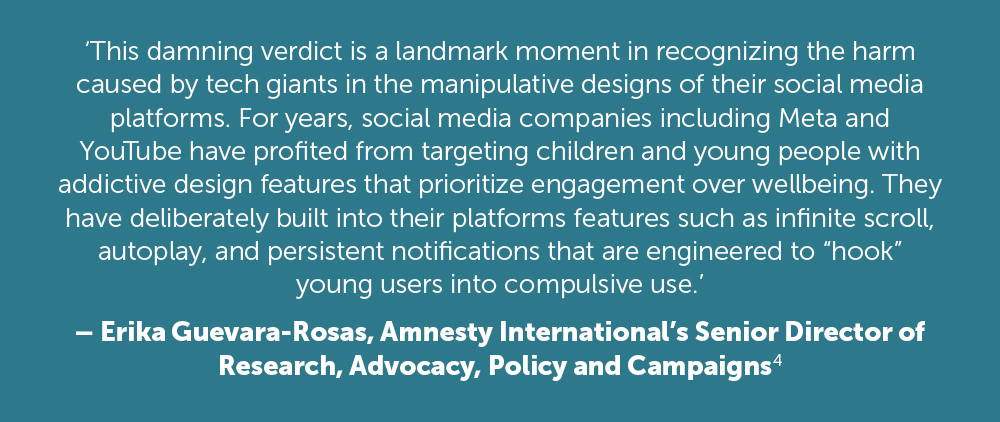
Earlier in that same week, Meta was ordered to pay $375 million after a jury in New Mexico found it ‘misled consumers about the safety of its platforms’.5 Meta was found liable for ‘the way in which its platforms endangered children and exposed them to sexually explicit material and contact with sexual predators’.2
In response to the outcome of the cases, the Tech Oversight Project celebrated: ‘The era of big tech invincibility is over.’5

Warning/disclaimer
The case relates to issues of mental health, self-harm, body dysmorphia, depression and suicidal thoughts. This might be triggering for some students. Use discretion in approaching the topic and remind students of available mental health resources.
 Activity
- Research the case KGM filed against Meta and watch the video about it above.
- As a class, discuss the significance of the verdict and the extent to which you agree or disagree with it.
The reward system of the brain and ethical responsibility
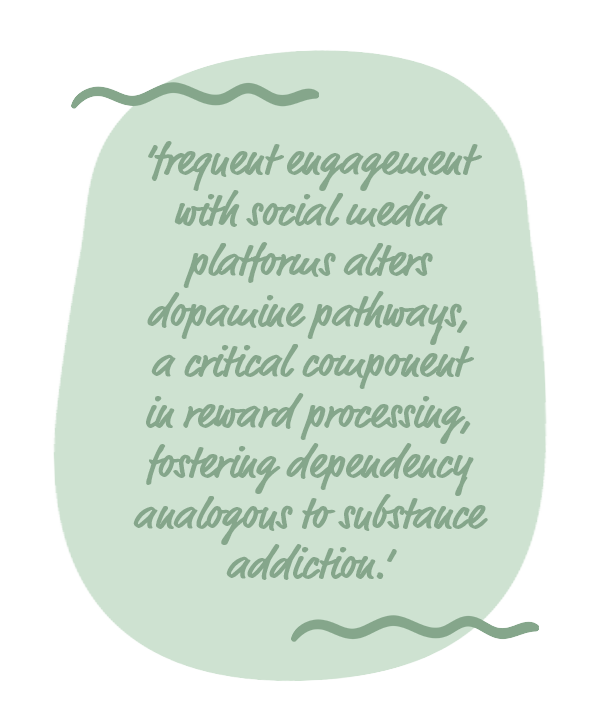
Prior to these most recent court cases, research into the neurophysiological impact of social media on adolescents concluded that ‘frequent engagement with social media platforms alters dopamine pathways, a critical component in reward processing, fostering dependency analogous to substance addiction.’6
The authors of the study raised concerns about the ethical responsibility of social media companies and highlighted the role of AI-driven algorithms which are designed to ‘capture our attention for profit’, ‘personalise content’ and ‘maximise screen time’.6
What next?
Many countries are planning to ban, or have already instituted social media bans, for young people.7 However, some are sceptical about their value and insist that government regulation of social media platforms should be the focus.
Ian Russell, a campaigner for online safety, argues that bans ‘lessen the pressure on tech firms to fix their products’.5 Instead, he insists: ‘We now need political will from governments to turn these landmark rulings into a fundamental shift in the business models and features that drive harmful content and keep our children hooked on social media’.5
Activity
Discuss the extent to which you agree or disagree with the following statement:
Social media bans for young people are effective ways to limit the potential harms of social media usage.
Find three sources which can be used as evidence to support your stance.
Tips for responsibly scrolling
The ‘infinite scroll’ is one feature on social media that makes it so difficult to tear yourself away from the screen. According to Sharon Horwood, senior lecturer in Psychology at Deakin University, this feature means there is no ‘natural stopping point’ or point at which you have caught up with everything for the day.8 It also endlessly tempts you, with ‘the promise of something good that might be just about to pop up in your feed’.8
Horwood suggests some tips for ‘taking back control’.8 There are the quick wins:8
- Create a break.
- Remove social media apps.
- Schedule scrolling time.
And then those that take more time and hard work. These involve reflecting on your relationship with social media and asking yourself:8
- What is the deeper reason for your scrolling?
- How much do you benefit from, or need, social media?
Activity
Reflect on your own use of social media by answering the following questions.
- How many hours do you spend on social media platforms each day
- How do you feel after being on social media?
- What benefit do you gain from social media?What are the negative effects?
- For a week, experiment with gradually decreasing the amount of time you spend on social media each day. Reflect on this experience and its impact.
- Discuss your responses with a classmate and come up with two strategies to encourage the responsible use of social media.6
- Share your ideas with the class. Together, create a list of helpful strategies that can be displayed on the classroom wall, as a reminder of your intentions regarding responsible social media use.
 If you fear you are addicted to social media, seek help from a trusted adult or mental health professional.
Interventions
The researchers who studied the neurophysiological impact of social media proposed some collaborative interventions, focusing on parental/guardian guidance, improved media literacy and ‘transparency in algorithmic operations’.6 While these groundbreaking legal verdicts will hopefully change regulations and the ways in which social media companies are allowed to operate in the long term, practical changes relating to adult support and oversight regarding internet usage, increased media literacy and peer-led support groups could have positive impacts in the short term.6
IMPORTANT DAYS THIS MONTH:
6: Family Day
7: World Health Day
22: International Earth Day
27: Freedom Day
April is Stress Awareness Month
If you are using the Achieve Careers LO Programme, the following information and activities are recommended to coincide with the theme of ‘toxic achievement culture’ and the important days above:
- Grade 7 LO Manual – Module 2 (Health & Well-Being) and Module 3 (Peer Pressure)
- Grade 8 LO Manual – Module 2 (Social Media) and Module 3 (Addiction)
- Grade 9 LO Manual – Module 3 (EQ: Mental Health & Mindfulness)
- Grade 10 LO Manual – Module 1 (Personal Branding) and Module 2 (Community Service)
- Grade 11 LO Manual – Module 1 (Interpersonal Skills & EQ) and Module 2 (Critical Thinking)
- Grade 12 LO Manual – Module 2 (Success Strategies)
- Grades 7, 8 and 9 CAPS Ebooks – Module 2 (Health, Social and Environmental Responsibility) and Module 3 (Constitutional Rights and Responsibilities)
- Grade 10 CAPS Ebook – Module 2 (Democracy and Human Rights)
- Grades 11 and 12 CAPS Ebooks – Module 2 (Social and Environmental Responsibility) and Module 3 (Democracy and Human Rights)
- Teacher’s Flash Drive – LO Resources – folders on Addiction, Democracy and Human Rights, Disordered Eating and Eating Disorders, Ethics, Health and Nutrition, Mental Health, Self-Esteem, Self-Harm, Stress
References:
- Democracy Now!, 2026. Meta & Google Found Liable in Landmark Cases for Knowingly Causing Harm to Young People
Available: bit.ly/MetaGoogleCases [1 Apr 2026]. Website: www.democracynow.org
- Hays, K., Saad, N. and Morris, R (2026) ‘Campaigners Welcome Meta and YouTube’s Defeat in Landmark Social Media Addiction Trial’, BBC, [Electronic], 27 Mar, Available: bbc.in/4m0EfP8 [1 Apr 2026].
- Nicholls, R. (2026) ‘Meta and Google Just Lost a Landmark Social Media Addiction Case. A Tech Law Expert Explains the Fallout’, The Conversation, [Electronic], 26 Mar, Available: bit.ly/TechLawExpert [31 Mar 2026].
- Amnesty International (2026) USA: Landmark YouTube and Meta Social Media Ruling Must Lead to Design Changes to Guarantee Online Safety, [Online], Available: bit.ly/DesignOnlineSafety [1 Apr 2026].
- Milmo, D. and Booth, R. (2026) ‘“The Era of Invincibility is Over”: The Week Big Tech was Brought to Heel’, The Guardian, [Electronic], 28 Mar, Available: bit.ly/BigTechHeel [1 Apr 2026].
- De, D., El Jamal, M., Aydemir, E. and Khera, A. (2025) ‘Social Media Algorithms and Teen Addiction: Neurophysiological Impact and Ethical Considerations’, Cureus, [Electronic], vol. 17, no. 1, 8 Jan, Available: bit.ly/NeurophysiologicalImpact [1 Apr 2026].
- Reuters (2026) From Australia to Europe, Countries Move to Curb Children’s Social Media Access, [Online], Available: reut.rs/4sLopux [1 Apr 2026].


